Listen to this episode on Spotify and Google Podcasts.
Today’s museum is one I wasn’t sure how long I would go before talking about it. If anyone follows the museum/ art world, then you are aware of the scandal that the Orlando Museum of Art found itself embroiled in early 2022 with their Basquiat exhibit. For those that don’t know, it’s an English equivalent of a Spanish telenovela with supposed bribes, claims of forgery, and even the FBI Art Crime team being called in. Maybe a movie will come out of it one day. At least a made for TV one. Who knows?
However, the Orlando Museum of Art, otherwise known as OMArt, is kind of THE museum in Orlando. So basically, there’s no way to completely avoid it for a good long time. The Orlando Museum of Art is actually right across the street from the Mennello Museum so you can hop from one museum to the other. If you are knocking out two museums at once, I would actually recommend going to the Mennello Museum first, and then move to the Orlando Museum of Art as the Mennello is considerably smaller.
The Orlando Museum of Art was started by a group of 25 community members in a public library in 1924 and originally was called the Orlando Art Association. It wasn’t until the passing of one of the members in 1959, Ms. Hattie Hudson, who hosted many of the meetings at her home, that the current location in Loch Haven Park came to be. The money from the sale of her home was used towards raising funds for the new arts center. The Loch Haven location opened up in 1960 and was initially called Loch Haven Art Center. The name change to Orlando ART Museum occurred in 1987, and by then it had already received its accreditation from the American Alliance of Museums.
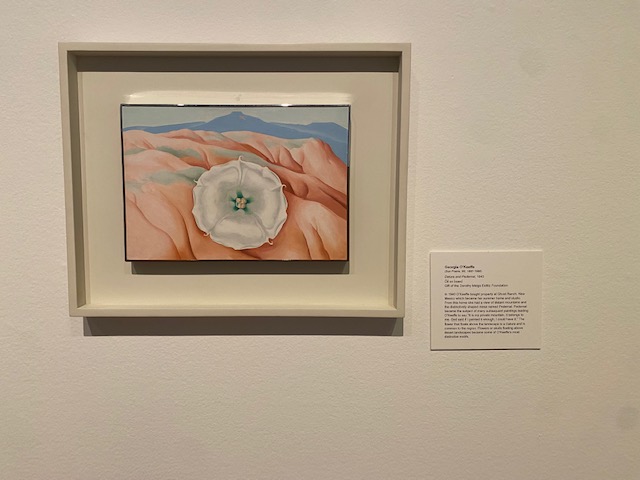
In the past, OMArt had the same exhibitions on display along two of its corridors so visiting it this time around was actually fun, because they changed a good number of the displays. They still have their Mesoamerican artifact exhibition up, which as a Latin American history minor, is actually awesome to have even if it’s a small corner of the museum. With this change in displays, you can see some really neat art prints in their Power of the Press exhibition. You get to see an Andy Warhol of Marilyn Monroe, and a Georgia O’Keefe (which oddly enough I had been thinking about O’Keefe for some time now).
Photo on the left is the piece “Sun Praire” by Georgia O’Keefe.
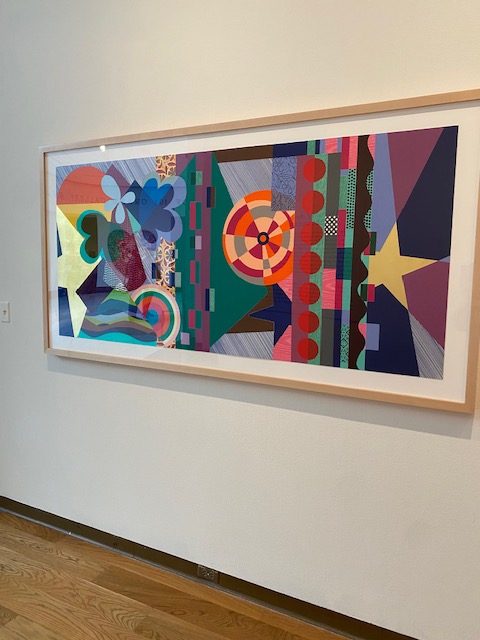
I personally gravitated more towards the piece Dovetail by Beatriz Milihazes (Brazil). I love color, so this screenprint was fabulous. It was just an explosion of color. There’s so much life and playfulness in the works. I had this feeling of going on your own Alice in Wonderland trip through the painting. Or maybe the Willy Wonka Chocolate Factory, if that’s more your style. Either way, I walked away from that painting light-hearted and bouncy, and with the mindset to view the impossible as possible. And that showcases what art can do – it can change a perspective or reinforce it.
Photo on the right is of the piece “Dovetail’ by Milihazes.
Just like at the Mennello Museum, OMart, similar to another local museum, is highlighting the post-immigrant experience by presenting the traveling exhibition “Don’t Ask Me Where I’m From.” This exhibit is talking about the immigrant experience, whether its second generation or first generation.
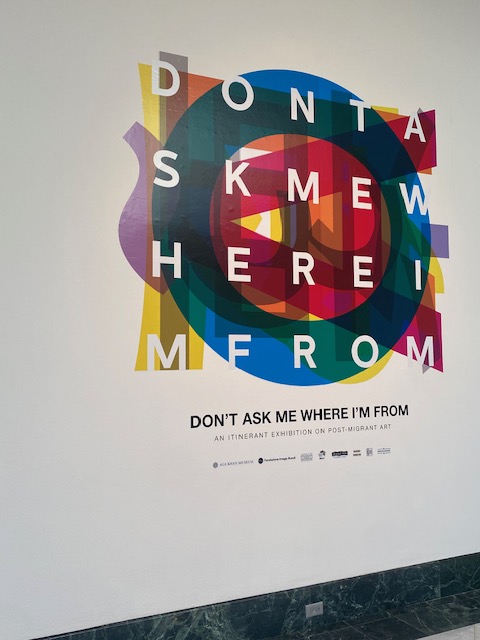
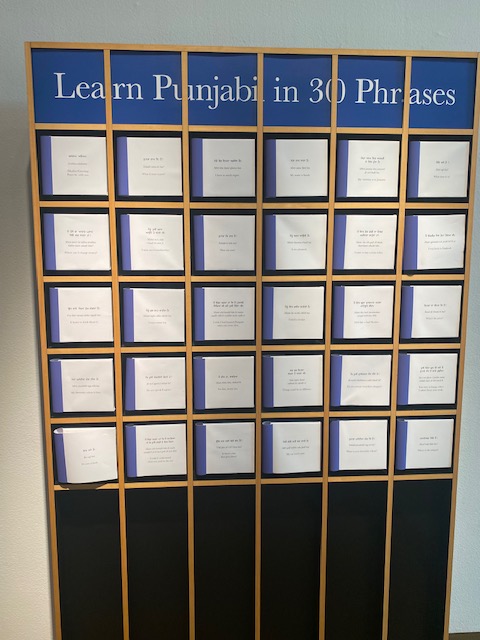
It may be that because I am from Puerto Rico and don’t experience the same level of differential treatment that can push people to want to hide the history of their family heritage, I actually wasn’t enthralled by it. While the cultural backgrounds were different, it seemed like the artists were given specific materials to work with and there was this repetition of artwork presentation that made the whole experience flat for me. It felt limited and constrained. But this may be one issue of traveling exhibitions. How do you safely get from one location to another, various artworks that took artists time and energy to conceptualize and then create? I’m sure the pandemic hasn’t made it any cheaper or easier to arrange the transfers. Sometime after I left the museum, I was thinking about the piece “Learn Punjabi in 30 Phrases” by Sarah Maple. I saw how commercialized language learning is, but at same time how heartbreaking and deep the process is for someone trying to connect their roots. So maybe it wasn’t as flat of an experience after all.
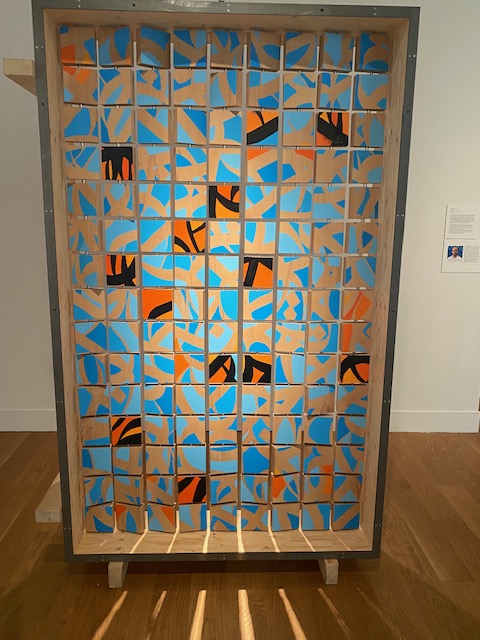
There was this repetition of a boxes/crates throughout the exhibition, that made me tune out as I walked through the displays. Photo to the right is of artwork by ELSEED.
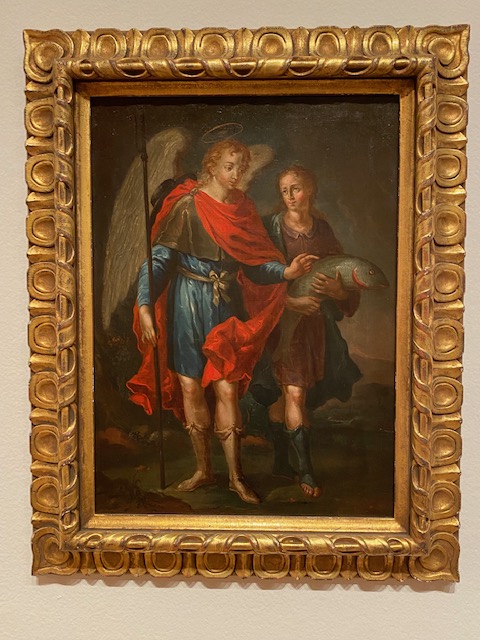
I actually was much more intrigued by their exhibit, From the Andes to the West Indies: Spanish Colonial Paintings from The Thoma Collection. I got there just in time for a lecture by Dr. Ilena Mendoza from the University of Central Florida. Which, lectures are another fabulous resource for you all to take advantage of! Some of the pieces in the exhibit were talked about in the lecture, so you get to hear some information that will help provide you with some history, some context to help you navigate the exhibit. Maybe you’ll learn some things that will spur you to investigate a little more on something in the exhibit. Dr. Mendoza explained how Jose Campeche, a Puerto Rican artist in the late 1700s, used the Rococo style in Caribbean paintings of local high-profile families and used local cultural aspects such as a type of flower, or a maraca, or a type of building in order to tell the story of the family he was painting and to depict where this is taking place. Campeche was little bit a Da Vinci in his own right – he was self-taught and dipped his toes in multiple arenas such as making musical instruments, architecture, and designing coat of arms.
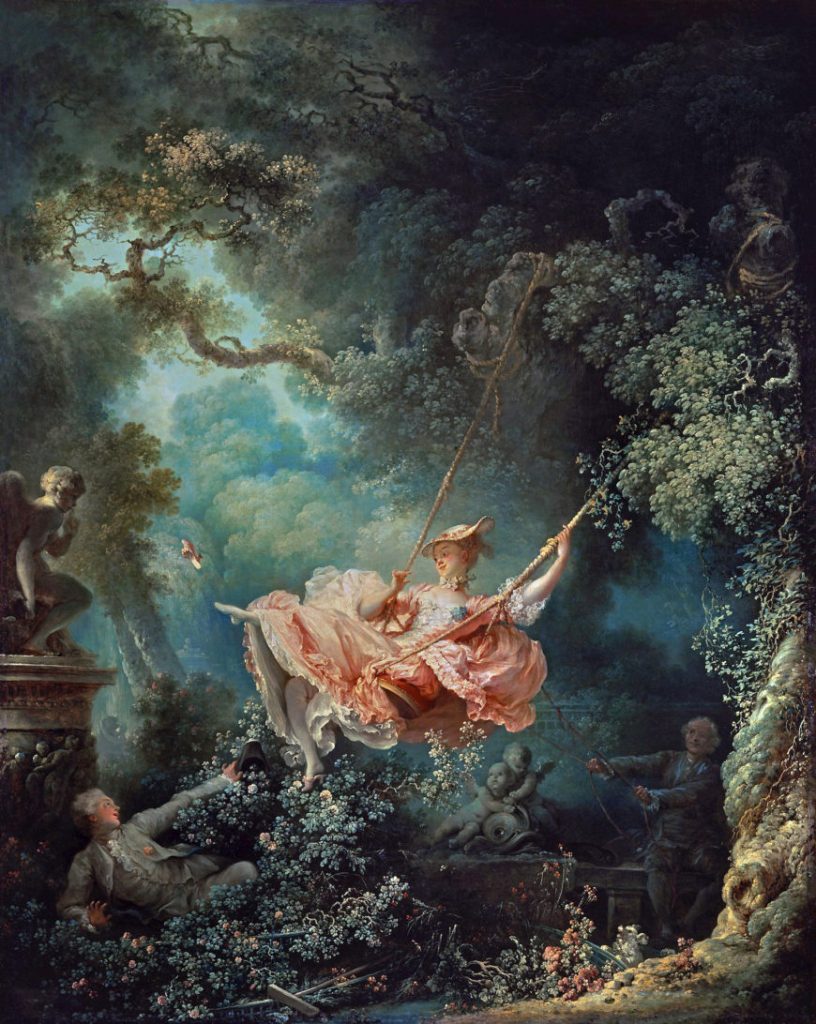
You might be asking, what is Rococo style art? The Rococo style was born in 18th century Paris, and this type of art has a lot of light-hearted colors and scenes, a lot of curved lines. Lots of scrollwork. This style began right at the heels of the Baroque style (which has its roots in Italy) so there is some similarity between them. The baroque style has a much more serious feel and color palate, whereas Rococo is really set apart by its sense of playfulness. Take a look at the 1767 painting of “The Swing” by Jean-Honore Fragonard for an idea of what Rococo is all about.
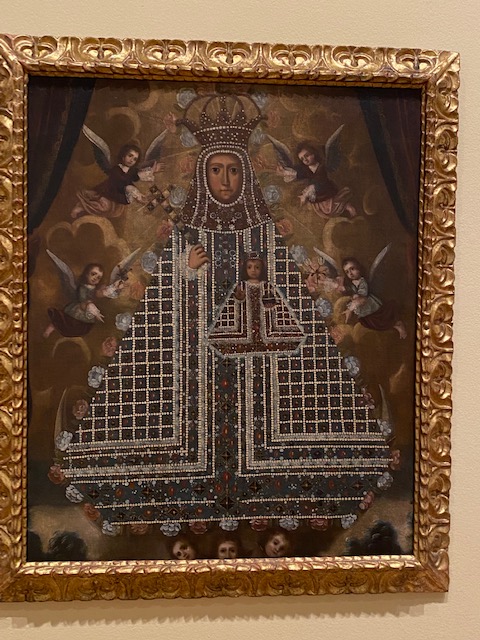
During the talk, Dr. Mendoza also touched upon painting templates. When looking at depictions of the Virgin Mary, a lot of times as an outsider, we can view these paintings and go “They always show the Virgin Mary in this exact same way, and the baby Jesus in the same way.” Well, I learned that the reason for that is that there is a template that was created hundreds of years before on how the subject of the painting is to be depicted. Therefore, you always see a depiction of that particular subject, such as the Virgin Mary floating in this belled triangular shape and holding baby Jesus, per said template, so that you could automatically know what the subject of the painting is regardless of the colors and items in the background.
I really had a great visit to the Orlando Museum of Art, and hearing Dr. Mendoza explaining some of the history of colonial Spanish painting really made a difference for me because I was no longer walking around trying to figure out what these artists were trying to tell me. I was walking through the exhibit armed with knowledge that helped me walk away with a much more fulfilling museum visit.
Check us out next month for our next adventure!
Museum Musings
A Florida-based museum exploration podcast and blog.
Social Media
Instagram
Where We Are
Orlando, FL
United States
Newsletter Subscription Form


 Museum Musings
Leave a comment